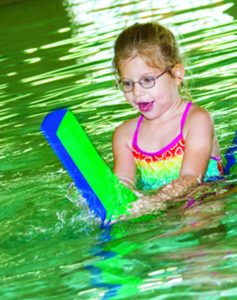


Children with special needs often do well in aquatic therapy because water is both supportive and adaptable. At Pediatric Therapy Center, every session is individualized to a child’s specific strengths and challenges.
This article explains why water helps and how our therapists adjust pediatric aquatic therapy for different needs.
Reducing the Effects of Gravity
On land, gravity can make posture and movement hard for children with muscle weakness or coordination challenges. In water, buoyancy carries part of that load. Children can practice upright positions and stepping movements with more independence than they have on land.
That independence creates room for repetition. A child who can take only a few supported steps in the gym may be able to practice many more in the pool, and repeated practice is what drives motor learning.
Supporting Muscle Tone Differences
Children with low muscle tone benefit from water resistance, which strengthens muscles gently without overwhelming the body. Children with high tone or spasticity may find that warm water and hydrostatic pressure help their muscles relax, which can make movement feel freer.
Because the same pool can both challenge and relax the body, a therapist can shape a session around what each child needs that day.
Promoting Motor Planning and Coordination
Aquatic sessions use structured activities that call for purposeful movement. A child may reach for a toy, kick toward a target, step over an obstacle or hold their balance while the water moves around them. Each task builds body awareness and coordination.
Children with autism often have motor planning differences as well. Our article on pediatric aquatic therapy for autism covers that in more detail.
A Setting That Encourages Participation
Many children are more willing to try new movements in the water. Movement feels easier, falls are less of a worry and the setting feels more like play than work. A child who is engaged practices more, and a child who practices more makes more progress.
Monitoring Progress Safely
Our therapists watch closely how each child responds and adjust activities to keep progress safe and measurable. Goals are functional. They may include sitting with less support, standing longer, walking with better balance or moving between positions more smoothly.
Aquatic therapy is usually one part of a wider plan. It often works together with land-based pediatric physical therapy and occupational therapy, and with pediatric speech therapy when communication goals are part of the picture.
Talk With Our Team
If you are wondering whether aquatic therapy could help your child, we are glad to talk it through. Contact Pediatric Therapy Center in Papillion or call 402-932-2782 to ask about an evaluation. You can also read about the key benefits of aquatic therapy for children.